Chua Non-Smooth
The non-smooth fractional Chua model with a linear-by-pieces characteristic: equations, parameters, equilibria, Matignon criterion, algebra validation, harmonic branches and EFORK status.
The Chua Non-Smooth model is the Danca benchmark used by this library.
Its diode characteristic is linear by pieces; this is the mathematical form
of the non-smooth model, not a separate piecewise system.
The order-one baseline is recorded separately in Chua Integer q=1 Reference.
Equations
The non-smooth characteristic can be written equivalently with an explicit absolute-value form (standard in textbooks) or with a saturation function:
The saturation form used in the algebraic derivation is identical:
Parameters
| Parameter | Symbol | Value | Description |
|---|---|---|---|
alpha | 8.4562 | coupling coefficient | |
beta | 12.0732 | third-equation coefficient | |
gamma | 0.0052 | third-equation damping | |
m0 | -0.1768 | inner regional slope | |
m1 | -1.1468 | outer regional slope | |
q | 0.9998 | fractional order (Caputo) |
from hidden_attractors import chua_nonsmooth_parameters

params = chua_nonsmooth_parameters()
Equilibria
| Equilibrium | |||
|---|---|---|---|
E0 | 0 | 0 | 0 |
E+ | 6.588307886539 | 0.002836402256 | -6.585471484283 |
E- | -6.588307886539 | -0.002836402256 | 6.585471484283 |
Python, MATLAB and Wolfram reproduce these values. The maximum Python equilibrium
residual is 1.10e-15.
from hidden_attractors.models import equilibria_nonsmooth, jacobian_nonsmooth, rhs_nonsmooth

eq = equilibria_nonsmooth(params)
dx = rhs_nonsmooth(eq["E+"], params)
J = jacobian_nonsmooth(eq["E+"], params)
Matignon Criterion
For , the threshold is radians.
| Region | Eigenvalues | Classification |
|---|---|---|
Inner, E0 | , | stable |
Outer, E+, E- | , | unstable |
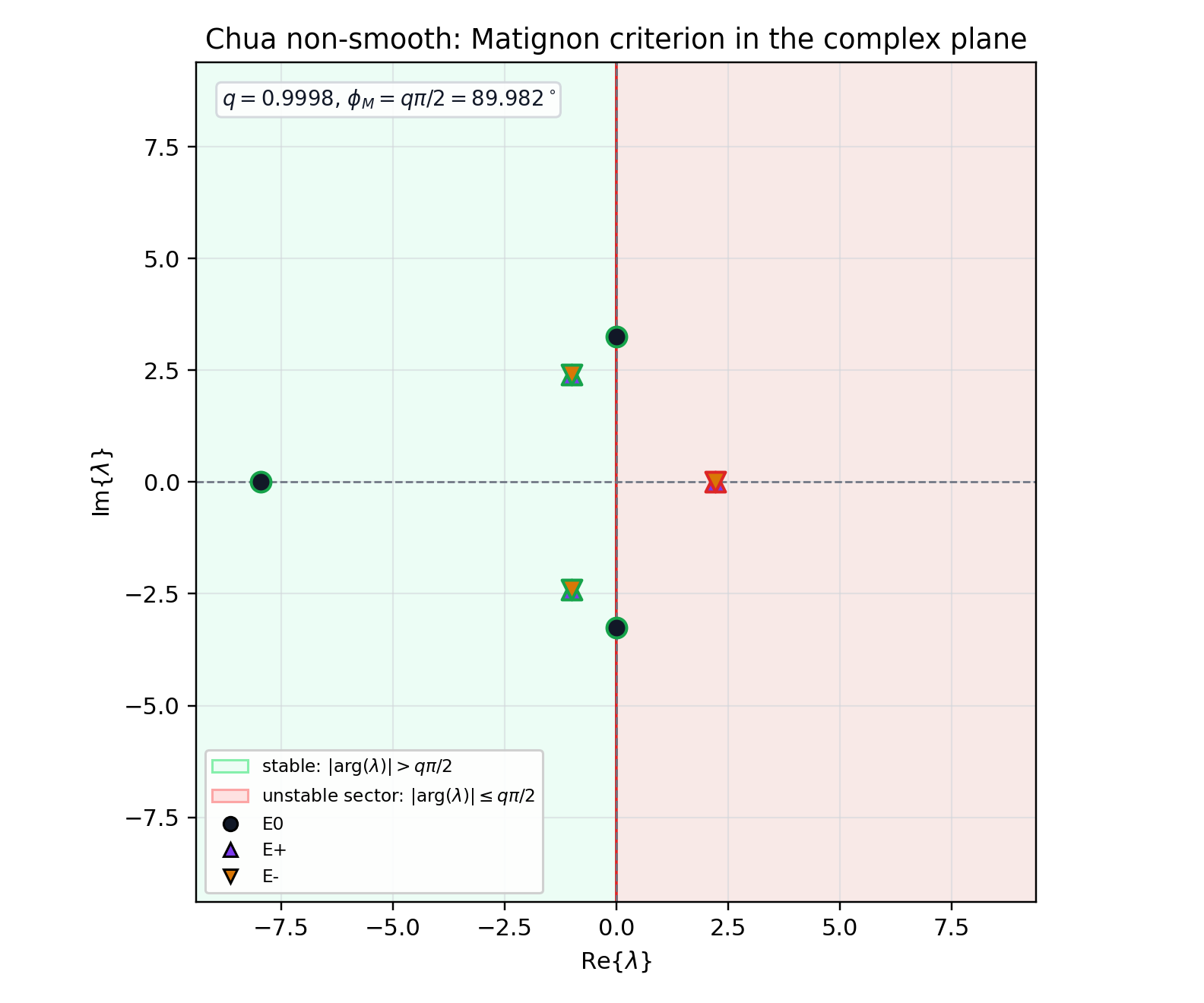
Python artifact: validation/01_algebra/matignon_complex_plane.png, generated by tools/validation/validate_chua_fractional_nonsmooth_algebra.py.
Algebra Validation at q=0.9998
This section records the first completed validation stage for the non-smooth fractional Chua case reported by Danca (2017). It validates equations, equilibria, regional Jacobians, the Lur’e split, and harmonic branches. It does not claim that numerical integration, chaos, or hiddenness have already been validated.
| Check | Acceptance tolerance | Recorded maximum error | Result |
|---|---|---|---|
| Equilibrium substitution in Python, MATLAB and Wolfram | passed | ||
| Symbolic/analytic Jacobian comparison | passed | ||
| Analytic Jacobian vs central differences | passed | ||
| Eigenvalues across tools | passed | ||
| Matignon classification | Same stable/unstable decision | same result | passed |
Transfer Sign Convention
MATLAB and the algebraic report use
while the Python seed API historically computes
Therefore these checks are equivalent:
Harmonic Branches
| Branch | Seed | |||
|---|---|---|---|---|
| 1 | 2.040286051079 | 0.210022792962 | 5.851767785486 | |
| 2 | 3.244926730975 | 0.956945404928 | 1.053016610257 |
After sign normalization, Python and MATLAB agree with a maximum closure
residual of 2.01e-13 and a maximum amplitude difference of 1.48e-12.
The supplied Wolfram Language source also verifies the symbolic identities
after renaming its protected identifier Tr.
Report Correction
The fractional non-smooth derivation in 170526.pdf correctly reaches
and for its stated transfer.
However, preceding general text and the later arctan balance section also
write without changing the transfer sign. Those occurrences must
be normalized to the minus convention, or the document must explicitly
redefine the transfer with the opposite sign.
Source Roles
| Source | Role in this validation |
|---|---|
| Danca (2017), Hidden Chaotic Attractors in Fractional-Order Systems | Direct published reference for this exact non-smooth model, parameter set, , and neighborhood test context. |
| Petras (2008), A Note on the Fractional-Order Chua’s System | Confirms the physical fractional PWL Chua model family; its parameter set and orders differ. |
| Sene (2021), Mathematical Views of the Fractional Chua’s Electrical Circuit Described by the Caputo-Liouville Derivative | Supports fractional Chua stability and dynamical reporting methods; its equations omit the damping term and are not direct numeric confirmation. |
Corrected EFORK Rerun
The former attractor image has been removed. It was generated before the
native EFORK stages were aligned with the published K3/known-history
formula. A new line-only rerun with the corrected EFORK backend, using the
Danca-replication seed, q=0.9998, h=0.05, and retained history over
T=500, converges toward E0:
| Diagnostic | Recorded value |
|---|---|
Final distance to E0 | |
| Post-transient range norm | |
| Classification | collapsed toward E0 |
Therefore no EFORK attractor is published on this page until a corrected integration locates a bounded, non-trivial orbit and the dynamic validation stage is repeated.
Validation Status
The algebra stage is complete. The next required evidence is integrator
convergence and independent-solver comparison. In particular, after correcting
the EFORK stage-history evaluation, the previously published dynamic figure is
not retained: the corrected full-history rerun from the Danca-replication seed
collapses toward E0. Bounded chaotic dynamics and hiddenness must be
revalidated before any attractor figure is promoted.